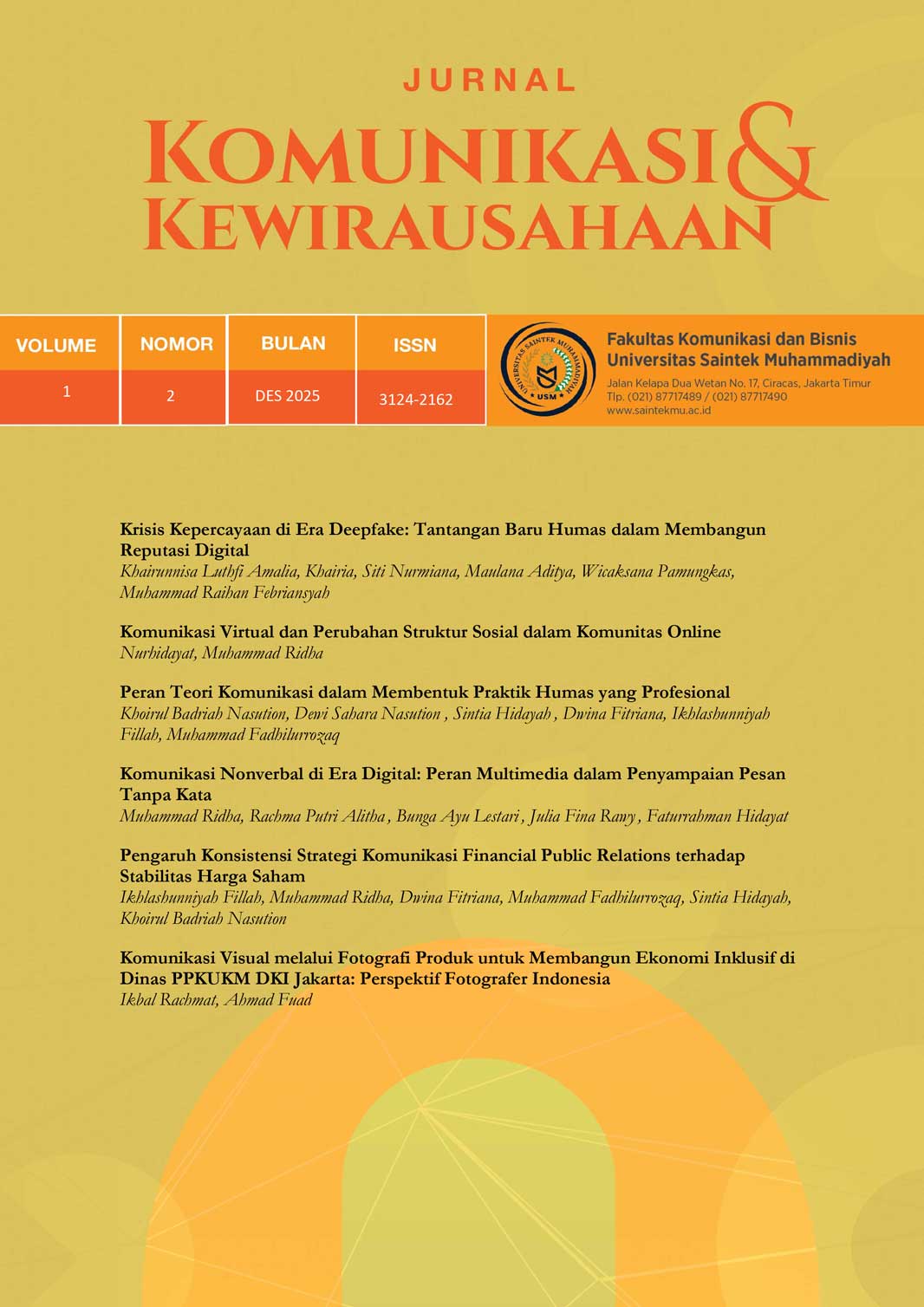
Krisis Kepercayaan di Era Deepfake: Tantangan Baru Humas dalam Membangun Reputasi Digital
DOI:
https://doi.org/10.56459/k86m4357Keywords:
Deepfake, Krisis Kepercayaan, Humas DigitalAbstract
Perkembangan teknologi kecerdasan buatan telah memunculkan fenomena deepfake yang secara signifikan mengubah lanskap komunikasi digital dan praktik kehumasan. Deepfake tidak hanya menghadirkan inovasi visual, tetapi juga menimbulkan krisis kepercayaan publik akibat meningkatnya potensi manipulasi informasi, serangan reputasi, dan disinformasi terstruktur. Penelitian ini bertujuan menganalisis bagaimana deepfake mempengaruhi kredibilitas institusi, serta menelaah strategi humas dalam menjaga dan memulihkan reputasi di era ketidakpastian digital. Metode yang digunakan adalah studi literatur terhadap penelitian lima tahun terakhir yang membahas isu deepfake, kepercayaan publik, manajemen krisis, dan reputasi digital. Hasil kajian menunjukkan bahwa deepfake telah menjadi ancaman strategis bagi legitimasi organisasi karena kemampuannya meniru suara, wajah, dan perilaku tokoh publik secara realistis sehingga memicu kerentanan terhadap misinformasi dan rekayasa citra. Temuan juga mengungkap bahwa efektivitas peran humas sangat bergantung pada kecepatan deteksi, transparansi komunikasi krisis, serta penguatan literasi digital publik. Oleh karena itu, humas perlu mengintegrasikan pendekatan berbasis teknologi, etika komunikasi, dan manajemen risiko untuk membangun ketahanan reputasi yang berkelanjutan di tengah ekosistem informasi yang semakin rentan terhadap manipulasi.
References
Acim, B., Boukhlif, M., Ouhnni, H., Kharmoum, N., & Ziti, S. (2025). A Decade of Deepfake Research in the Generative AI Era, 2014–2024: A Bibliometric Analysis. Publications, 13(4), 50.
Azka, M. D. A., Aulia, N. F., Ananda, F., & Putra, P. (2025). Pengaruh Deepfake terhadap Kepercayaan Publik pada Informasi Visual di Media Sosial. Kajian Administrasi Publik dan ilmu Komunikasi, 2(2), 286-301.
Boediman, E. P. (2025). Exploring the impact of deepfake technology on public trust and media manipulation: A scoping review. Jurnal Komunikasi, 19(2), 131-152.
Diel, Alexander, et al. "Human performance in detecting deepfakes: A systematic review and meta-analysis of 56 papers." Computers in Human Behavior Reports 16 (2024): 100538.
Europol, Z. (2022). Facing reality? Law enforcement and the challenge of deepfakes.
Firc, A., Malinka, K., & Hanáček, P. (2025). Evaluation framework for deepfake speech detection: a comparative study of state-of-the-art deepfake speech detectors. Cybersecurity, 8(1), 50.
Gupta, G., Raja, K., Gupta, M., Jan, T., Whiteside, S. T., & Prasad, M. (2023). A comprehensive review of deepfake detection using advanced machine learning and fusion methods. Electronics, 13(1), 95.
Hameleers, M., & Marquart, F. (2023). It’s nothing but a deepfake! The effects of misinformation and deepfake labels delegitimizing an authentic political speech. International Journal of Communication, 17, 21.
Hameleers, M., & Marquart, F. (2023). It’s nothing but a deepfake! The effects of misinformation and deepfake labels delegitimizing an authentic political speech. International Journal of
Lee, F. Y., Kumaresan, S. P., Anaam, E. A., & Kong, W. C. (2025). Social Platforms in the Deepfake Age: Navigating Media Trust through Media Literacy. JOIV: International Journal on Informatics Visualization, 9(1), 176-183.
Lundberg, E., & Mozelius, P. (2025). The potential effects of deepfakes on news media and entertainment. AI & SOCIETY, 40(4), 2159-2170.
Momeni, M. (2025). Artificial intelligence and political deepfakes: Shaping citizen perceptions through misinformation. Journal of Creative Communications, 20(1), 41-56.
Plohl, N., Mlakar, I., Aquilino, L., Bisconti, P., & Smrke, U. (2025). Development and Validation of the perceived deepfake trustworthiness questionnaire (PDTQ) in three languages. International Journal of Human–Computer Interaction, 41(11), 6786-6803.
Qureshi, S. M., Saeed, A., Almotiri, S. H., Ahmad, F., & Al Ghamdi, M. A. (2024). Deepfake forensics: a survey of digital forensic methods for multimodal deepfake identification on
Singh, S., & Dhumane, A. (2025). Unmasking digital deceptions: An integrative review of deepfake detection, multimedia forensics, and cybersecurity challenges. MethodsX, 103632.
Weikmann, T., & Lecheler, S. (2024). Cutting through the hype: Understanding the implications of deepfakes for the fact-checking actor-network. Digital Journalism, 12(10), 1505-1522.
Whittaker, L., Mulcahy, R., Russell-Bennett, R., Letheren, K., & Kietzmann, J. (2025). Examining Consumer Appraisals of Deepfake Advertising and Disclosure: Show Deepfakes as “Real Life” or Say They’re “Just Fantasy”?. Journal of Advertising Research, 1-22.
Zhang, B., Cui, H., Nguyen, V., & Whitty, M. (2025). Audio deepfake detection: What has been achieved and what lies ahead. Sensors (Basel, Switzerland), 25(7), 1989.
Harianja, M. D. M., Ridha, M., Salmawati, S., Waduha, S., & Ni’mah, F. (2025). Analisis Iklim Komunikasi Organisasi dalam Meningkatkan Efektivitas Kerja, Kepuasan Karyawan dan Kualitas Hubungan Antar Anggota di Lingkungan Kerja Modern. Jurnal Komunikasi dan Kewirausahaan, 1(1), 13-20.
Azzahra, N., Ridha, M., Andefta, N. M., Ilahi, R., & Sari, V. K. (2025). Analisis keterkaitan kepemimpinan, komunikasi efektif dan kinerja dalam efektivitas organisasi profesional. Jurnal Komunikasi dan Kewirausahaan, 1(1), 1-6.
Ridha, M., Astiani, D., Azkia, A., Ramadhani, A., & Zain, F. M. (2025). Kekuatan Komunikasi: Fungsi dan Dampaknya Terhadap Kehidupan Manusia. Komsospol, 5(1), 48-54.